ONE MAN’S VIEW OF HISTORY.
Posted: 15 Jan 2026, 03:02
ONE MAN’S VIEW OF HISTORY.
A friend once bought me a tee-shirt that said on the front ‘You can always tell someone that comes from Barnoldswick, but you can’t tell them much’. I occasionally wear the shirt but I don’t believe the message. My experience of Barlickers is that they like to learn and most of all they like to hear stories about the town and the people in it, they call it history.
I have to make a serious confession here, I’m an ‘off-comed un’. I was born in Stockport, came to Earby in 1956 where I ran a grocer’s shop and didn’t move to Barlick until 1959 when I bought Hey Farm off ‘Sailor’ Brown. So, I’ve only lived here for 41 years and hope you won’t hold it against me. Like many young lads, I was never turned on by history at school. They tried to teach me about Kings and Queens and politicians and battles and all it did was turn me off. It wasn’t until my natural curiosity surfaced and I recognised that history wasn’t just Kings and Queens that I developed a serious interest in history. I was a long distance driver at the time and as I drove round the country I started to wonder who built the roads, what made towns spring up where they did and who on earth had been digging holes all over the landscape? I started reading and discovered that everything you saw and every person you met had a history that was far more important than Kings, Queens and politicians because without the little people the big ones couldn’t function. It wasn’t Royalty that built the towns and factories and ran the industries that created the wealth that made the big houses and high-living possible it was little people like you and me who actually did the work, paid the price and made ‘History’ possible.
For the last thirty years I have spent much of my spare time digging into Barlick history and trying to make sense of what I saw around me. I have to admit that my primary interest isn’t what has been written down already but what I can discover for myself by talking to people, recording their memoirs, closely observing the ground and asking why it is the shape that it is. Written records are useful in their place, they give us many clues but you really start to learn when you actually walk the ground and use your imagination. This means that you get it wrong quite often but occasionally you can start a hare off which interests other people and they go out and do more work on the problem. The result is wider understanding but you never have the complete answer, there is always something new to learn.
I’m retired now, they have decided that as I can’t lift heavy weights any more I’m surplus to requirements. That’s OK, it gives me time to drag a lot of research together and try to make sense of the town I know. I want to write this down and share it with the people who made it possible, ordinary Barlickers. This will lead to several books which may or may not get published but the brave editors of the BET have said that they will publish occasional pieces as long as I keep the sex and violence down. I can’t promise that I will do this of course because, human beings being what they are, it’s part of history. So, be patient with me and remember that I never claim to be right, I just have an opinion.
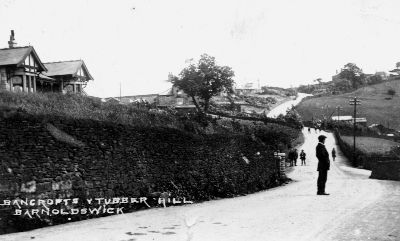
I love old pictures and the information we can glean from them. This postcard of Tubber Hill looks to be around 1920. The man in the road is stood in front of Windy Harbour, the cottages which stood on the triangle of land at the head of Gillian's Lane. The road is white because it was a water-bound macadam surface of crushed limestone. The number of people on the road doesn't indicate any special occasion, this was most likely Sunday and having a walk was a cheap and popular pastime. Many a courtship started like this. Half way up the hill on the right you can see two wooden huts at the head of the road down to Lane Bottoms. These were the premises of Jim Haworth, 'the firewood king' who, with his mate Jim Rushton was one of the founders of the Communist Party in Barlick, we'll meet them later. On the crest of the hill to the right is Sagar's new house and I think the smaller building behind it could be Upper Hall. Notice the telegraph pole, the telephone had arrived for the better off.
14 April, 2000
A friend once bought me a tee-shirt that said on the front ‘You can always tell someone that comes from Barnoldswick, but you can’t tell them much’. I occasionally wear the shirt but I don’t believe the message. My experience of Barlickers is that they like to learn and most of all they like to hear stories about the town and the people in it, they call it history.
I have to make a serious confession here, I’m an ‘off-comed un’. I was born in Stockport, came to Earby in 1956 where I ran a grocer’s shop and didn’t move to Barlick until 1959 when I bought Hey Farm off ‘Sailor’ Brown. So, I’ve only lived here for 41 years and hope you won’t hold it against me. Like many young lads, I was never turned on by history at school. They tried to teach me about Kings and Queens and politicians and battles and all it did was turn me off. It wasn’t until my natural curiosity surfaced and I recognised that history wasn’t just Kings and Queens that I developed a serious interest in history. I was a long distance driver at the time and as I drove round the country I started to wonder who built the roads, what made towns spring up where they did and who on earth had been digging holes all over the landscape? I started reading and discovered that everything you saw and every person you met had a history that was far more important than Kings, Queens and politicians because without the little people the big ones couldn’t function. It wasn’t Royalty that built the towns and factories and ran the industries that created the wealth that made the big houses and high-living possible it was little people like you and me who actually did the work, paid the price and made ‘History’ possible.
For the last thirty years I have spent much of my spare time digging into Barlick history and trying to make sense of what I saw around me. I have to admit that my primary interest isn’t what has been written down already but what I can discover for myself by talking to people, recording their memoirs, closely observing the ground and asking why it is the shape that it is. Written records are useful in their place, they give us many clues but you really start to learn when you actually walk the ground and use your imagination. This means that you get it wrong quite often but occasionally you can start a hare off which interests other people and they go out and do more work on the problem. The result is wider understanding but you never have the complete answer, there is always something new to learn.
I’m retired now, they have decided that as I can’t lift heavy weights any more I’m surplus to requirements. That’s OK, it gives me time to drag a lot of research together and try to make sense of the town I know. I want to write this down and share it with the people who made it possible, ordinary Barlickers. This will lead to several books which may or may not get published but the brave editors of the BET have said that they will publish occasional pieces as long as I keep the sex and violence down. I can’t promise that I will do this of course because, human beings being what they are, it’s part of history. So, be patient with me and remember that I never claim to be right, I just have an opinion.
I love old pictures and the information we can glean from them. This postcard of Tubber Hill looks to be around 1920. The man in the road is stood in front of Windy Harbour, the cottages which stood on the triangle of land at the head of Gillian's Lane. The road is white because it was a water-bound macadam surface of crushed limestone. The number of people on the road doesn't indicate any special occasion, this was most likely Sunday and having a walk was a cheap and popular pastime. Many a courtship started like this. Half way up the hill on the right you can see two wooden huts at the head of the road down to Lane Bottoms. These were the premises of Jim Haworth, 'the firewood king' who, with his mate Jim Rushton was one of the founders of the Communist Party in Barlick, we'll meet them later. On the crest of the hill to the right is Sagar's new house and I think the smaller building behind it could be Upper Hall. Notice the telegraph pole, the telephone had arrived for the better off.
14 April, 2000